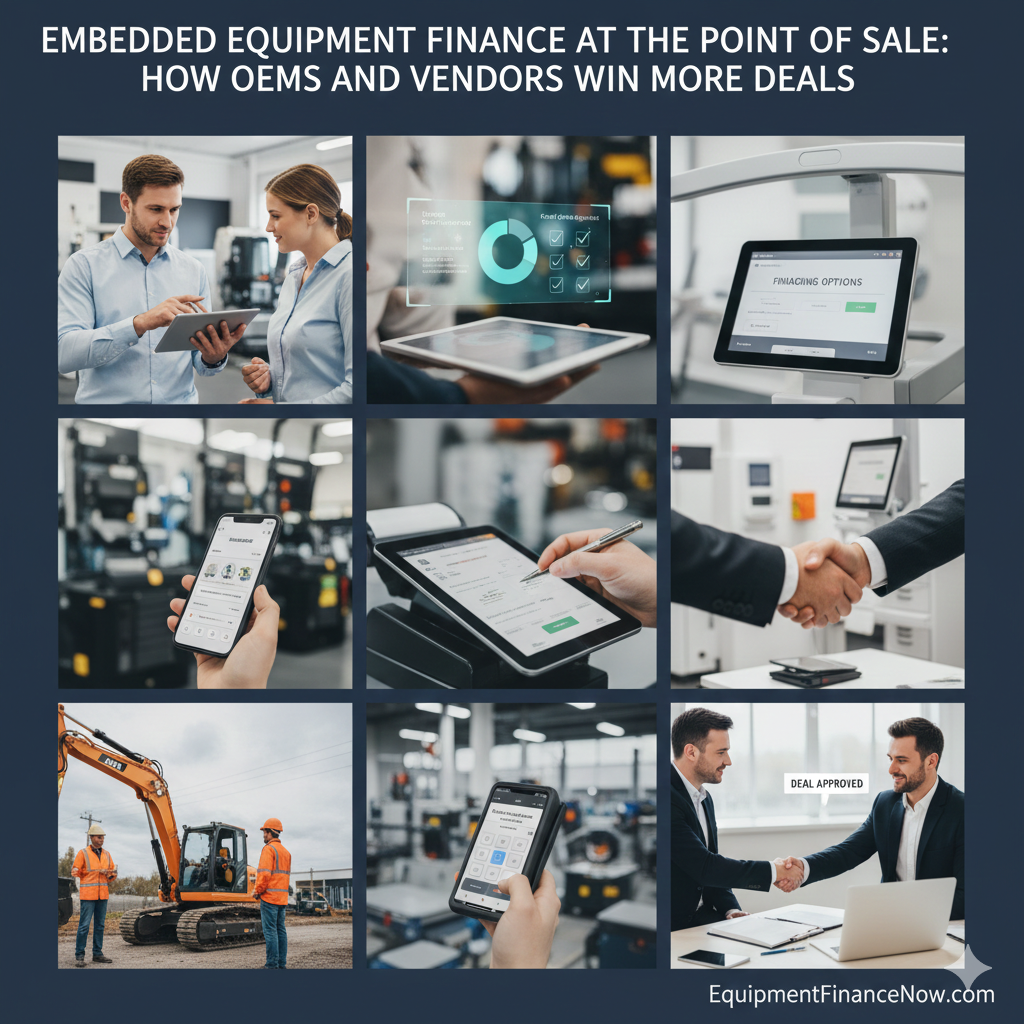
Embedded equipment finance at the point of sale has moved from experimental to essential in the last five years, especially in capital-intensive B2B sectors where buying cycles are long and margins are thin (Market.us, “Embedded Lending Market Size, Share,” 2025).
Embedded lending platforms now dominate the embedded lending solution market with nearly 70 percent share, and North America alone accounts for more than one-third of global embedded lending volume, underscoring the scale of the opportunity for equipment lenders that can plug into OEMs, vendors, and marketplaces at the moment of decision (Market.us, “Embedded Lending Market Size, Share,” 2025).
Why Embedded at Point of Sale Matters
When a mid-market manufacturer can click “Finance in minutes” on an OEM portal and receive an instant lease or loan decision, the lender has shifted from a back-office utility to a growth driver. QuickFi, for example, enables OEMs to deliver fully digital, self-service equipment loans and leases 24/7 at the OEM, dealer, or e-commerce point of sale, with repeat transactions completed in minutes (QuickFi, “The New Financing Opportunity for Original Equipment Manufacturers,” 2024).
This model allows OEMs to control the customer financing experience while funding can still come from third-party banks or finance companies, proving that lenders do not need to own the customer interface to own significant volume (QuickFi, “The New Financing Opportunity for Original Equipment Manufacturers,” 2024).
Industry research suggests that embedded finance will be a core growth driver across vertical SaaS, marketplaces, and B2B platforms, with embedded finance revenue in the United States alone already reaching tens of billions of dollars (McKinsey & Company, “Embedded Finance: Who Will Lead the Next Payments Revolution?,” 2021). B2B marketplaces that embed financing at checkout routinely report double-digit percentage increases in transaction volume, driven by higher conversion and reduced friction around payment and terms (Fintechtris, “Embedded Finance + B2B Platforms: The Next Frontier in Fintech,” 2025). These trends suggest that equipment lenders that remain “off-platform” will steadily cede relevant deal flow to lenders that are integrated deep into OEM and marketplace workflows.
The Strategic Role of OEM Partnerships
Original equipment manufacturers sit closest to the customer’s equipment decision and therefore control the most valuable real estate for finance: the product configurator, quote, and order page. Embedded finance platforms now let OEMs stand up a “virtual captive” that appears fully owned and controlled by the manufacturer, while loans and leases may still be funded by partner banks and independent finance companies behind the scenes (QuickFi, “The New Financing Opportunity for Original Equipment Manufacturers,” 2024).
This model creates a powerful alignment: the OEM maintains brand control and customer experience, while the lender gains privileged, pre-qualified access to demand that would otherwise be intermediated by brokers or competitive lenders.
Several white-labeled platforms illustrate how lenders and OEMs can structure these arrangements. Jifiti, for instance, provides an infrastructure through which banks and lenders can offer competitive financing programs directly to OEMs, who in turn extend them through retailers, resellers, dealers, and their own direct sales channels (Jifiti, “White-Labeled OEM Finance Solutions,” 2025).
In practice, this means a forklift manufacturer, a CNC machine OEM, or an industrial HVAC provider can offer consistent financing options whether the customer buys online, from a dealer, or through a marketplace listing. Exhibit 1 could map this “OEM-led embedded finance stack,” showing the OEM front end, embedded decisioning layer, and one or more lender balance sheets that sit underneath.
OEM-embedded finance also unlocks first-party credit and usage data that can improve underwriting and lifecycle marketing. When OEMs can observe both equipment performance and financing behavior in one environment, lenders that partner on these platforms can design highly specific upgrade, renewal, and add-on financing offers.
QuickFi emphasizes that OEMs using its platform gain access to valuable customer credit data that can feed future AI-driven marketing and sales efforts, which in turn increases repeat equipment sales and financing volume (QuickFi, “The New Financing Opportunity for Original Equipment Manufacturers,” 2024). The lender that knows when a compressed-air system is approaching its operating threshold or when a leased asset is underutilized can present intelligent refinancing, buyout, or replacement options at exactly the right moment.
Real-World Illustrations from Equipment Lenders
An OEM-focused embedded platform such as QuickFi offers a clear real-world view of how equipment lenders can reposition around OEM workflows. QuickFi’s model enables OEMs to set terms and conditions while still using external capital sources, reducing the need for OEMs to build full captive organizations while preserving lender participation opportunities (QuickFi, “The New Financing Opportunity for Original Equipment Manufacturers,” 2024).
For the participating equipment lender, the embedded relationship produces highly standardized, low-friction transactions that can often be completed at a fraction of traditional delivery costs, in some cases at less than one-third the per-transaction cost of legacy processes (QuickFi, “The New Financing Opportunity for Original Equipment Manufacturers,” 2024).
Other equipment lending implementations demonstrate the power of end-to-end automation. TurnKey Lender’s case studies describe equipment finance providers that automated in-house lending operations, from application through underwriting to servicing, achieving dramatic cycle-time reduction and improved portfolio visibility (TurnKey Lender, “Case Study: Equipment Finance Process Automation,” 2022).
When those same capabilities are embedded at the OEM or vendor point of sale, the lender does not just process applications faster; the lender reshapes the sales motion itself, enabling sales teams to quote monthly payments, structure financing alternatives, and close deals within a single digital experience. Exhibit 2 could summarize before-and-after metrics such as time to approval, approval rate, and attach rate to illustrate the impact of embedded, automated workflows on lender economics.
B2B platforms that incorporate working-capital and equipment financing demonstrate additional upside. Embedded lending providers report that supplier and marketplace platforms that integrate financing into the transaction flow often see 15 to 25 percent increases in volume, driven by higher average order values and improved checkout completion (Fintechtris, “Embedded Finance + B2B Platforms: The Next Frontier in Fintech,” 2025). Equipment lenders that partner with such platforms can capture these incremental volumes without proportional increases in acquisition spend or sales headcount; the platform effectively becomes a continuous origination engine.
Vendors, Resellers, and Dealer Networks
Beyond OEMs, vendor and reseller networks offer another rich channel for embedded equipment finance at the point of sale. A white-labeled platform can enable vendors to offer consistent financing across online and in-store environments, whether the customer is buying directly from the OEM, through a dealer, or via a reseller (Jifiti, “White-Labeled OEM Finance Solutions,” 2025).
For lenders, this distributed network poses both complexity and opportunity: complexity because each channel has different sales motions, opportunity because each node in the network can originate incremental deals when equipped with embedded finance tools.
A disciplined approach starts with identifying anchor vendors whose product lines align well with the lender’s target asset profile and risk appetite. Industrial machinery dealers, commercial vehicle resellers, and technology VARs often handle high-ticket transactions where financing is the default rather than the exception. Embedded lending platforms that integrate via APIs allow these vendors to surface pre-configured financing offers on quotes, invoices, and digital carts, dramatically reducing the friction of separate credit applications.
Market data confirms that embedded lending platforms, which provide such integrated capabilities, dominate the broader embedded lending market because they streamline credit services and improve the user experience through quick approvals and automated decisions (Market.us, “Embedded Lending Market Size, Share,” 2025).
In practice, successful vendor-embedded programs share several traits. First, they standardize offers—clear term lengths, transparent buyout options, and simplified documentation—so that salespeople can confidently present financing without becoming credit experts. Second, they design simple seller tools: one-click “Add financing” buttons in CPQ systems, finance widgets in dealer portals, and mobile interfaces for field reps.
Third, they install clear service rails so that customers receive consistent support whether they originated financing at a dealership, via an online store, or through a marketplace. Exhibit 3 could outline a sample dealer onboarding and enablement plan, from training and collateral to embedded portal configuration.
Marketplaces and B2B Platforms
B2B marketplaces and vertical SaaS platforms are rapidly becoming the next frontier for embedded finance, including equipment finance. Bain and others project that embedded B2B payments alone will reach trillions of dollars in volume in the next few years, and embedded lending is riding the same structural tailwinds as buyers demand seamless, integrated financial solutions (Fintechtris, “Embedded Finance + B2B Platforms: The Next Frontier in Fintech,” 2025). Marketplaces that embed working-capital and equipment financing at checkout can increase volume, capture additional margin, and create defensible switching costs as financing relationships deepen.
For equipment lenders, a marketplace partnership typically involves integrating underwriting, pricing, and documentation into the marketplace’s transaction engine. The marketplace provides transaction data, seller performance metrics, and sometimes asset details; the lender provides decisioning and capital.
Embedded lending platforms make these integrations scalable by offering credit-as-a-service infrastructure and APIs that can be tailored to the marketplace’s workflows (Market.us, “Embedded Lending Market Size, Share,” 2025). In this three-way partnership described in Exhibit 4—the marketplace, the embedded platform, and the lender—the lender gains diversified deal flow across many sellers, while the marketplace can offer fast, branded financing experiences without building a balance sheet.
A critical consideration is that B2B marketplace financing often requires nuanced product design. Unlike simple BNPL for consumers, equipment and working-capital products must support milestone funding, seasonal payment schedules, and asset-backed security structures. Leading embedded lending providers already support a range of commercial models, including merchant cash advances, revenue-based financing, and trade credit automation, illustrating that flexible product architectures are both possible and commercially viable (Market.us, “Embedded Lending Market Size, Share,” 2025). Equipment lenders that can adapt their structures—such as tailoring balloon payments to residual values or aligning repayment with project milestones—will be better positioned to win marketplace deals.
Economics and KPIs (Exhibits 1–4)
The economics of embedded equipment finance differ from traditional models primarily in acquisition cost, scale of originations, and lifetime value. Market data suggests that embedded lending platforms can process transactions at significantly lower operational cost per deal than traditional manual workflows, sometimes at less than one-third the cost (QuickFi, “The New Financing Opportunity for Original Equipment Manufacturers,” 2024). Combined with higher attach rates at the point of sale and increased repeat usage, this efficiency can materially improve a lender’s unit economics even when per-deal margins compress slightly due to OEM or marketplace revenue shares.
Key performance indicators for embedded equipment finance programs should reflect both lender-specific and partner-specific objectives. On the lender side, core metrics include cost per booked contract, approval rate, portfolio yield, loss rate, and lifetime value by channel. On the partner side, metrics such as equipment sales lift, average ticket size, financing attach rate, and customer satisfaction scores matter as much as pure finance metrics.
B2B platforms that have successfully embedded finance often report 15 to 25 percent volume increases, a useful benchmark for OEMs and lenders when modeling business cases (Fintechtris, “Embedded Finance + B2B Platforms: The Next Frontier in Fintech,” 2025). Exhibit 2, for instance, could benchmark pre- and post-embedding performance across these metrics for a representative OEM-lender program.
Lenders should also model capital and risk dynamics explicitly. Embedded programs can generate large volumes quickly, which tests funding capacity and risk management. Market research indicates that large enterprises are currently the strongest adopters of embedded lending solutions, suggesting that initial volumes may skew toward larger, better-capitalized customers (Market.us, “Embedded Lending Market Size, Share,” 2025).
Still, as embedded finance expands into the SME and long tail of B2B buyers, lenders must maintain disciplined underwriting, portfolio concentration limits by OEM or marketplace, and robust early warning systems that use both transactional and behavioral data.
Technology and Integration Considerations
Technology is the backbone of embedded finance partnerships. Embedded lending platforms provide the APIs, decision engines, and digital contracting tools that make point-of-sale financing possible within OEM, vendor, and marketplace environments (Market.us, “Embedded Lending Market Size, Share,” 2025).
The most successful equipment lenders adopt one of two approaches: build a modern, API-first lending stack that can integrate directly with partners, or leverage a third-party embedded platform that intermediates the technical complexity. In both cases, the lender must support near-instant decisions, paperless documentation, and real-time status updates back to the OEM or marketplace.
A typical integration roadmap begins with defining the user journeys and screen placements where financing options will appear. Next, the lender and partner agree on data payloads for pre-qualification, full application, and booking, as well as on error handling and exception flows. Case studies of automated equipment finance implementations show that fully integrated digital lending, from online application through approval and documentation, can dramatically shorten cycle times and reduce manual work (TurnKey Lender, “Case Study: Equipment Finance Process Automation,” 2022). Exhibit 1 could depict a reference architecture that includes the OEM or marketplace front end, the embedded lending platform or lender APIs, and the back-end servicing and funding systems.
Critical integration priorities include identity verification, digital signatures, and compliance logging. Lenders must ensure that KYC and AML checks occur seamlessly within the embedded flow, without forcing users to leave the OEM or marketplace environment. They must also maintain compliant e-signature and recordkeeping processes even when documents are presented through partner-branded front ends. Some embedded platforms store digital chattel paper in secure digital vaults, giving OEMs more treasury flexibility while preserving enforceability for lenders (QuickFi, “The New Financing Opportunity for Original Equipment Manufacturers,” 2024).
Risk, Compliance, and Governance
Embedded equipment finance does not eliminate risk; it redistributes it and makes its management more complex. Lenders must navigate shared-brand risk with OEMs and marketplaces, ensuring that marketing and customer communications remain accurate, transparent, and compliant. Industry commentary notes that successful embedded partnerships combine the compliance strength of traditional banks with the innovative user experiences of fintechs, suggesting a collaborative model rather than a pure outsourcing approach (Market.us, “Embedded Lending Market Size, Share,” 2025).
A robust governance framework should define responsibilities across the lifecycle. OEMs and marketplaces should handle customer acquisition language, high-level positioning of finance offers, and basic front-line support, guided by lender-approved content. Lenders should retain authority over underwriting policies, adverse action notices, collections practices, and regulatory reporting.
McKinsey’s analysis of embedded finance stresses that banks and lenders that move early can shape these governance norms and secure leading positions in emerging ecosystems (McKinsey & Company, “Embedded Finance: Who Will Lead the Next Payments Revolution?,” 2021). Exhibit 3 might outline a RACI matrix describing which party is responsible, accountable, consulted, and informed for each major process step.
Risk management also extends to partner selection and monitoring. Lenders should develop clear criteria for choosing OEMs, vendors, and marketplaces, including industry risk, customer segment, geographic exposure, and operational maturity. Ongoing monitoring should track not only default rates but also complaint levels, mis-selling indicators, and brand risks.
Embedded finance case studies show that platforms increasingly rely on AI-driven fraud detection and risk scoring, leveraging transaction data and behavioral signals to prevent abuse (Market.us, “Embedded Lending Market Size, Share,” 2025). Equipment lenders can tap into these tools through their platform partners or build their own analytics layers that ingest partner data feeds.
Designing the Customer and Seller Experience
The success of embedded equipment finance ultimately depends on the day-to-day experiences of buyers and sellers. For buyers, the ideal journey is a single, coherent flow from equipment selection through financing and closing. Successful embedded implementations offer transparent display of payment options, clear comparisons between lease and loan structures, and real-time updates on status.
QuickFi’s approach of enabling nearly instant self-service equipment financing at all hours illustrates the standard buyers increasingly expect: no phone calls, minimal data entry, and rapid, definitive outcomes (QuickFi, “QuickFi’s Embedded Finance Platform Is Revolutionizing Equipment Finance,” Monitor Daily, 2025).
For sellers—OEM reps, dealer salespeople, and marketplace sellers—the experience must enhance rather than complicate the sales process. Tools should allow them to generate finance-enabled quotes, send links for remote completion, and track where buyers are in the approval process in real time.
Embedded finance programs that deliver higher approval rates and faster decisions tend to see strong adoption among sales teams, especially when commissions recognize financed deals appropriately. B2B platforms that integrated financing into their core workflows report meaningful growth in transaction volumes, suggesting that sellers respond positively when financing increases their close rates and order sizes (Fintechtris, “Embedded Finance + B2B Platforms: The Next Frontier in Fintech,” 2025).
An effective way to design these experiences is to prototype screens and flows jointly with OEM or marketplace stakeholders and front-line users. Exhibit 4 could show sample wireframes for an OEM product page with embedded finance options and a dealer portal view with integrated financing status. User testing should validate that financing options are easy to find, simple to understand, and framed in a way that supports, rather than distracts from, the core equipment value proposition.
Building a Partner Portfolio Strategy
No single OEM or marketplace partnership will define an equipment lender’s embedded future; enduring advantage will come from a thoughtfully constructed portfolio of partnerships. Lenders should segment partners into tiers based on strategic fit, volume potential, and integration depth. Top-tier partners—often major OEMs or large B2B platforms—warrant deeper technical integration, joint marketing, and dedicated support. Mid-tier partners may use standardized embedded financing modules, while smaller vendors and resellers might be served through lightweight, configurable portals.
Market research indicates that large enterprises currently lead in adoption of embedded lending, but growth in SME-focused solutions is accelerating as platforms expand into supply-chain and trade-credit use cases (Market.us, “Embedded Lending Market Size, Share,” 2025).
Equipment lenders should therefore balance near-term volume opportunities with large OEMs and platforms against the longer-term potential of distributed networks of smaller vendors and online marketplaces. Each segment may require different risk models, product structures, and service approaches, but a shared embedded infrastructure can serve them all.
A portfolio strategy also helps mitigate concentration risk. By distributing exposure across multiple OEMs and marketplaces, lenders reduce the impact of any single partner’s performance or strategic shift. Portfolio-level analytics can reveal which partners deliver the best combination of volume, risk-adjusted yield, and operational efficiency.
Over time, lenders can use these insights to renegotiate terms, invest more in high-performing relationships, or exit underperforming ones.
Practical Conclusion
Embedded equipment finance at the point of sale is reshaping how capital flows into productive assets, shifting origination from stand-alone finance channels into OEMs, vendor networks, and B2B marketplaces. Market data and real-world implementations make clear that embedded lending platforms reduce per-transaction costs, increase approval and attach rates, and unlock new volumes by integrating finance directly into buying journeys (QuickFi, “The New Financing Opportunity for Original Equipment Manufacturers,” 2024; Market.us, “Embedded Lending Market Size, Share,” 2025).
For equipment lenders, the opportunity is not simply to digitize existing processes but to become an invisible, indispensable layer beneath the sales infrastructure of industrial and commercial ecosystems.
The path forward is practical and actionable. Lenders can begin by targeting one or two OEMs or platforms that align with their asset focus, designing an embedded program with clear economics, defined governance, and a well-architected technology integration. They can adopt or partner with embedded lending platforms that accelerate time to market, while still preserving control over underwriting and portfolio management.
As they prove success, they can expand into vendor networks and marketplaces, building a diversified portfolio of embedded relationships that collectively define their future distribution model.
Equipment lenders that embrace this shift will not be waiting for deals to be sent to them; they will be present at the moment of decision, shaping how modern businesses invest in the equipment that drives their growth.
References
Fintechtris. “Embedded Finance + B2B Platforms: The Next Frontier in Fintech.” Fintechtris, 25 September 2025. https://www.fintechtris.com/blog/embedded-finance-b2b-next-frontier-fintech
Jifiti. “White-Labeled OEM Finance Solutions.” Jifiti, 15 January 2025. https://www.jifiti.com/use-cases/sector/oem-finance
Market.us. “Embedded Lending Market Size, Share | CAGR of 20%.” Market.us, 25 November 2025. https://market.us/report/embedded-lending-market
McKinsey & Company. “Embedded Finance: Who Will Lead the Next Payments Revolution?” McKinsey & Company, 2021. https://www.mckinsey.com/industries/financial-services/our-insights/embedded-finance-who-will-lead-the-next-payments-revolution
Monitor Daily. “QuickFi’s Embedded Finance Platform Is Revolutionizing Equipment Finance.” Monitor Daily, 29 May 2025. https://www.monitordaily.com/article/quickfi
QuickFi. “The New Financing Opportunity for Original Equipment Manufacturers.” QuickFi, 2 July 2024. https://quickfi.com/oem-embedded-equipment-finance
TurnKey Lender. “Case Study: Equipment Finance Process Automation.” TurnKey Lender, 17 February 2022. https://www.turnkey-lender.com/case-studies/equipment-finance-end-to-end-automation-of-digital-lending-in-house
Harvard Library. “Chicago – Citations.” Harvard Library Research Guides, 25 March 2020. https://guides.library.harvard.edu/schlesinger/citation_guide/chicago
0 Comments