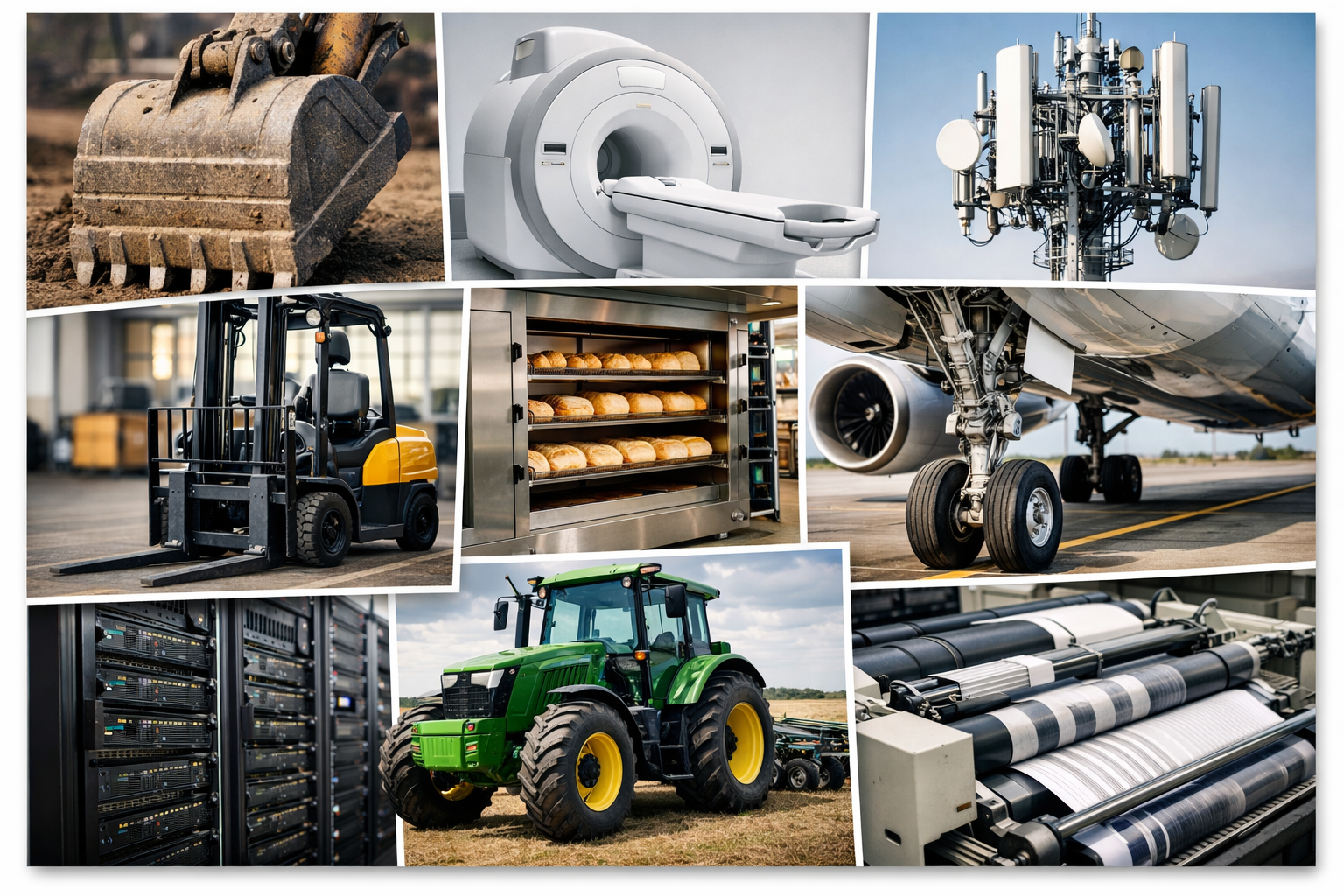
Equipment finance professionals operate in one of the most dynamic and essential segments of commercial lending. Every piece of machinery, every vehicle, every technological tool that powers modern enterprise depends on the capital that equipment lenders provide.
The equipment finance market grew from $1.302 trillion in 2024 to $1.437 trillion in 2025, a 10.4% annual growth rate (The Business Research Company, 2025). This growth reflects a major shift driven by new technology, changing customer needs, and strong economic conditions. In 2025, about 58% of all equipment and software purchases are financed through loans, leases, or credit lines (Equipment Leasing & Finance Foundation, 2024).
This growth trajectory demonstrates in 2026 and beyond, not merely the size of the industry but its fundamental importance to economic expansion across every sector of the American economy.
Equipment lenders who understand the nuanced differences between sectors—their profitability drivers, residual value characteristics, credit risk profiles, and technological disruption patterns—position themselves to capture market share and build portfolios that weather economic cycles.
Consider the independent equipment finance company that focused exclusively on medical imaging equipment in the early 2010s: by developing deep expertise in residual values, regulatory compliance, and provider cash flow patterns, that lender achieved portfolio returns 240 basis points higher than diversified competitors while maintaining charge-off rates below 50 basis points.
Specialization, when executed with discipline, creates competitive moats that generalists cannot easily breach.
The equipment finance industry saw 3.1% growth in new business volume in 2024 despite tightening credit conditions, with captive finance companies growing 5.9% and independent lenders expanding 17.7% (Equipment Leasing and Finance Association, 2025 Survey of Equipment Finance Activity, August 2025).
These data points reveal opportunity for lenders who identify the right sectors and execute with precision.
The Hierarchy of Profitability and Volume
1. Transportation Equipment (Trucks, Trailers, and Fleet Vehicles)
Transportation equipment commands the largest share of equipment financing volume, representing 23.7% of all new business volume in 2023 (Equipment Leasing and Finance Association, 2025 Survey of Equipment Finance Activity, August 2025). Within this category, trucks and trailers alone accounted for 16.5% of total financing volume, ranking as the third most-financed equipment type across all industries.
The sector’s dominance stems from several structural factors. Fleet turnover occurs on predictable cycles, typically every five to seven years for Class 8 trucks, creating recurring demand that transcends economic cycles. Residual values, while subject to freight market volatility, remain relatively predictable due to robust secondary markets and well-established valuation methodologies.
The Commercial Vehicle Financing Market reached $145.06 billion in 2025 and projects growth at 3.71% CAGR through 2034, with electric vehicle financing emerging as a significant driver (Market Research Future, cited in Suite by Monitor, “Trucking Businesses in 2025: A Deep Dive for Equipment Financiers,” February 2025).
Profitability in transportation equipment financing depends on sophisticated credit analysis that accounts for freight rate cycles, driver availability, fuel cost trends, and regulatory compliance burdens. The most successful transportation equipment lenders develop specialized underwriting that evaluates not merely balance sheet strength but operational metrics including revenue per truck, deadhead percentages, and customer concentration.
Vendor finance flows in commercial vehicles peaked at $145 billion in 2022 before contracting 8-10% in 2023-2024, reflecting both reduced demand and heightened lender caution in response to overcapacity concerns (Equipment Leasing and Finance Association, cited in Suite by Monitor, “Trucking Businesses in 2025: A Deep Dive for Equipment Financiers,” February 2025).
2. Agricultural Equipment
Agricultural equipment ranks as the second most-financed equipment type and represents the largest end-user industry by new business volume (Equipment Leasing and Finance Association, 2025 Survey of Equipment Finance Activity, August 2025). The agricultural sector demonstrates unique characteristics that create both opportunity and risk for equipment lenders.
Farm equipment financing volume correlates strongly with commodity prices, crop insurance payouts, and land values. A combine harvester costing $500,000 to $750,000 represents a significant capital commitment for farming operations that may generate highly variable annual revenue depending on weather, global commodity markets, and input costs.
Equipment lenders specializing in agriculture develop deep understanding of growing seasons, crop insurance mechanics, government support programs, and the seasonal cash flow patterns that distinguish agricultural borrowers from other commercial customers.
Residual values for agricultural equipment remain robust due to strong global demand, particularly from emerging markets. Technology integration—precision agriculture systems, GPS guidance, yield monitoring, and autonomous operation capabilities—has increased the complexity and value of modern agricultural equipment, creating opportunities for technology-focused lease structures that allow farmers to upgrade as innovation accelerates.
3. Construction Equipment and Machinery
Construction equipment represents the third major pillar of equipment finance volume, with construction ranking as the second-largest end-user industry by new business volume (Equipment Leasing and Finance Association, 2025 Survey of Equipment Finance Activity, August 2025). The construction equipment sector demonstrates high sensitivity to interest rates, infrastructure spending, and commercial real estate development cycles, creating volatility that disciplined lenders can exploit for premium returns.
Private financing activity in construction equipment reached 78% in 2023, indicating that more than three-quarters of construction equipment acquisitions involved some form of financing (Equipment Leasing & Finance Foundation, Equipment Finance Industry Horizon Report 2024, 2024).
Construction businesses demonstrate high propensity to finance equipment for several reasons: capital intensity of equipment relative to project revenue, project-based cash flow patterns that favor operating lease structures, and rapid technological advancement that encourages upgrade cycles.
Equipment lenders serving construction develop specialized expertise in contractor financial statements, project backlog analysis, bonding relationships, and equipment utilization metrics. A successful construction equipment lender evaluates not merely current financial performance but the strength of project pipelines, customer diversification, geographic market dynamics, and management depth.
Smart construction equipment financing now frequently incorporates telematics data and fleet management software, with technology reducing operating costs by up to 15% and providing lenders enhanced visibility into collateral utilization and location (Accenture, cited in Suite by Monitor, “Trucking Businesses in 2025: A Deep Dive for Equipment Financiers,” February 2025).
4. Information Technology and Computer Equipment
IT equipment and related technology services represented 11.4% of equipment financing new business volume in 2023, ranking as the fourth most-financed equipment type (Equipment Leasing and Finance Association, Equipment Finance in the IT/Computer Sector, 2024). Information technology equipment financing encompasses servers, storage systems, networking equipment, endpoint devices, and increasingly, software-as-a-service subscriptions bundled with hardware deployments.
Technology equipment financing presents unique challenges and opportunities. Accelerated obsolescence shortens useful life compared to trucks or construction equipment, requiring lease terms that match economic depreciation rather than physical durability.
The shift from capital expenditure to operating expenditure models—cloud computing, managed services, and subscription software—has transformed IT financing from simple equipment leasing to complex structures that bundle hardware, software, services, and support into unified monthly payments.
Equipment-as-a-Service (EaaS) models proliferate in the IT sector, with flexible financing combining hardware, software, and managed service costs into single monthly structures that eliminate capital expenditure hurdles (Financial Partners Group, “The Major Trends Shaping Equipment Financing in 2025,” June 2025).
Short-term leases with upgrade options every 24-36 months have become essential for businesses requiring cutting-edge infrastructure. Technology adoption drivers—artificial intelligence, cloud-first operations, cybersecurity upgrades—push IT departments toward financing models that provide flexibility and preserve capital for strategic initiatives.
5. Medical and Healthcare Equipment
Medical equipment financing represents one of the highest-growth and most profitable niches in equipment finance. The global medical equipment financing market reached $199.97 billion in 2025 and forecasts growth to $380.37 billion by 2034, demonstrating a robust compound annual growth rate driven by technological innovation, aging populations, and expanding healthcare access (Precedence Research, “Medical Equipment Financing Market Size and Forecast 2025 to 2034,” May 2025).
Healthcare equipment encompasses diagnostic imaging systems (MRI, CT, ultrasound), therapeutic equipment (radiation therapy systems, surgical robots), patient monitoring systems, and laboratory equipment. Equipment costs frequently exceed $1 million for advanced imaging systems, creating significant financing opportunities.
Hospitals and clinics accounted for 38.8% of medical equipment financing market share in 2025, representing the largest customer segment (Coherent Market Insights, “Global Medical Equipment Financing Market Size & Trends, 2032,” February 2025).
Profitability in medical equipment financing stems from several favorable characteristics. Healthcare providers demonstrate lower credit risk than many commercial borrowers due to diversified revenue sources including government reimbursements, private insurance, and patient payments.
Equipment residual values remain strong due to robust secondary markets and refurbishment channels. Technological advancement drives frequent upgrade cycles—a hospital may replace imaging equipment every seven to ten years to maintain competitive advantage and clinical capabilities.
The 2024 market valued medical equipment financing at $159.90 billion, with hospitals and clinics rapidly adopting newly launched medical systems due to adequate funding availability from finance companies (Fortune Business Insights, “Medical Equipment Financing Market Size, Share, Growth,” April 2025).
6. Materials Handling Equipment
Materials handling equipment—forklifts, pallet jacks, conveyor systems, automated storage and retrieval systems—ranks as the fifth most-financed equipment type by volume (Equipment Leasing and Finance Association, 2025 Survey of Equipment Finance Activity, August 2025). The sector benefits from broad economic exposure across manufacturing, distribution, retail, and logistics operations.
Materials handling equipment financing demonstrates stable performance characteristics. Equipment residual values remain predictable due to standardized designs and robust secondary markets. Lease structures typically span three to five years, matching equipment economic life with financing terms. E-commerce growth drives sustained demand for warehouse automation and materials handling capacity, creating secular growth tailwinds independent of broader economic cycles.
The most successful materials handling equipment lenders develop relationships with dealers and manufacturers, establishing vendor finance programs that capture transactions at point of sale. These programs provide competitive advantages through speed of execution, simplified documentation, and integrated sales processes that make financing invisible to end customers.
7. Manufacturing Equipment and Machine Tools
Manufacturing equipment encompasses machine tools, fabrication equipment, industrial robots, computer numerical control (CNC) systems, and specialized production machinery. The sector demonstrates strong correlation with industrial production indexes and capital expenditure cycles but offers attractive risk-adjusted returns for lenders with sector expertise.
Private financing activity for industrial equipment reached 78% in 2023, matching construction equipment for highest penetration rates across equipment categories (Equipment Leasing & Finance Foundation, Equipment Finance Industry Horizon Report 2024, 2024). Manufacturing businesses finance equipment to preserve working capital, match equipment payments to production revenue, and maintain financial flexibility for market opportunities.
Equipment lenders serving manufacturers develop expertise in production economics, capacity utilization analysis, customer contract structures, and supply chain dynamics. A manufacturer financing a $2 million CNC machining center presents different risk characteristics than a manufacturer financing 20 units of $100,000 equipment—concentration versus diversification, custom versus commodity, and financial leverage considerations all influence credit decisions and pricing.
8. Wholesale and Retail Trade Equipment
Wholesale and retail trade ranked as the third-largest end-user industry by new business volume in 2023 (Equipment Leasing and Finance Association, 2025 Survey of Equipment Finance Activity, August 2025). Equipment requirements span point-of-sale systems, refrigeration equipment, shelving and displays, delivery vehicles, and specialized retail technology.
Retail equipment financing expanded significantly with the proliferation of contactless payment systems, digital signage, and omnichannel fulfillment technologies. Retailers increasingly view equipment financing as strategic enabler rather than necessary evil—financing preserves capital for inventory, marketing, and real estate while providing flexibility to refresh technology as consumer preferences evolve.
The franchise sector within retail demonstrates particularly strong financing characteristics. Franchise operations benefit from proven business models, brand recognition, and standardized equipment packages, reducing credit risk for lenders. Franchise equipment financing often incorporates manufacturer or franchisor support, creating three-party structures that enhance credit quality and streamline documentation.
9. Food Service and Restaurant Equipment
Restaurant and food service equipment financing serves independent restaurants, franchise operations, institutional kitchens, hotels, and catering services. The North America equipment services and leasing services market in foodservice demonstrates robust growth driven by high equipment costs, rapid technology evolution, and capital constraints among small and medium-sized operators (Grand View Research, “North America Equipment Services & Leasing Services Market in Foodservice,” October 2024).
Independent restaurants accounted for 40% of foodservice equipment market share in 2024, representing the largest segment (Grand View Research, “North America Equipment Services & Leasing Services Market in Foodservice,” October 2024). These operators increasingly use equipment leasing to manage high costs of quality kitchen appliances without large upfront capital expenditures, preserving cash flow for working capital and marketing investments.
Commonly leased restaurant equipment includes point-of-sale systems, dishwashers, ice machines, walk-in coolers and freezers, espresso machines, ventilation systems, ovens, griddles, and ranges (Back Office, “Restaurant Equipment Leasing vs. Buying,” December 2025). Equipment with high maintenance costs and rapidly evolving technology—particularly POS systems—prove more economical to lease, while longer-life stainless steel pieces may be better suited for purchase. Restaurant equipment financing requires understanding of thin profit margins, high business failure rates, location economics, and cuisine-specific equipment requirements that distinguish this sector from other commercial lending.
10. Professional Services and Office Equipment
Professional services businesses—legal, accounting, consulting, engineering, architectural—represented significant volume within the “other services” category that ranked as the fourth-largest end-user industry in 2023 (Equipment Leasing and Finance Association, 2025 Survey of Equipment Finance Activity, August 2025). Equipment requirements include office furniture, computer systems, specialized software, printing and reproduction equipment, and increasingly, remote work infrastructure.
Professional services firms demonstrate attractive credit characteristics including recurring revenue models, high gross margins, low capital intensity, and strong cash flow generation. Equipment financing for professional services typically structures as fair market value leases or technology refresh programs that allow firms to maintain current capabilities without balance sheet impact.
The shift to hybrid work models created new equipment financing opportunities as firms invest in video conferencing technology, collaboration platforms, and distributed IT infrastructure. Professional services equipment financing increasingly bundles hardware, software, and managed services into unified monthly payments that simplify vendor management and provide predictable technology spending.
11. Renewable Energy Equipment
Renewable energy equipment financing—solar panels, wind turbines, battery storage systems, electric vehicle charging infrastructure—represents a high-growth niche driven by sustainability initiatives, regulatory incentives, and declining technology costs. Equipment lenders targeting niche markets like solar and oil demonstrate strong growth potential (Equipment Finance News, “Equipment lenders look to niche markets for growth,” August 2025).
Solar panel leasing allows businesses to adopt renewable energy with zero upfront capital through fixed monthly payments ranging from $50-$250 for 20-25 year terms (Insight Energy Systems, “How Does Leasing Solar Panels Work,” November 2025). The leasing company owns panels and handles maintenance while customers pay monthly fees to use generated electricity. This structure removes upfront cost barriers but means customers cannot claim the 30% federal solar tax credit since leasing companies own systems and receive tax benefits.
Renewable energy equipment leasing provides businesses several advantages: no upfront capital requirements, improved cash flow through fixed monthly payments, 100% tax-deductible lease payments as operating expenses (unlike capital purchases with gradual depreciation), and flexibility to upgrade equipment as technology evolves (Lease Energy, “Why Businesses are Choosing to Embrace Renewable Energy Equipment Leasing,” August 2025). Monthly lease payments spread costs over time while businesses immediately benefit from energy savings, creating positive cash flow from day one in many installations.
12. Telecommunications Equipment
Telecommunications equipment financing serves wireless carriers, internet service providers, enterprise communications departments, and data center operators. Equipment encompasses cell towers, fiber optic networks, switches and routers, satellite communications systems, and 5G infrastructure.
The telecommunications sector demonstrates unique financing characteristics including long asset lives (10-20 years for tower infrastructure), high initial capital requirements, and technology obsolescence risk as standards evolve from 4G to 5G to future generations. Successful telecommunications equipment lenders structure financing that matches cash flow generation to payment schedules while building in flexibility for technology upgrades and capacity expansion.
Rural broadband expansion and 5G deployment create sustained equipment financing demand. Government infrastructure programs provide subsidies and guarantees that enhance credit quality for telecommunications projects serving underserved markets, creating opportunities for lenders willing to navigate regulatory requirements.
13. Oil and Gas Equipment
Oil and gas equipment financing serves exploration, production, midstream, and oilfield services companies. Equipment includes drilling rigs, completion equipment, pumps and compressors, pipeline infrastructure, storage tanks, and production facilities. The sector demonstrates high cyclicality correlated to energy prices but offers attractive returns during expansion phases.
Equipment lenders serving oil and gas develop specialized expertise in reserve-based lending, commodity price hedging, production decline curves, and regulatory compliance requirements. Credit structures frequently incorporate borrowing bases tied to proven reserves, providing downside protection during commodity price declines. Equipment residual values fluctuate significantly with industry cycles—drilling rigs commanding premium prices during booms may have limited markets during downturns.
The energy transition creates both risks and opportunities for oil and gas equipment financing. Traditional equipment faces potential stranded asset risk as renewable energy expands, but natural gas equipment benefits from its role as transition fuel. Successful lenders in this sector maintain disciplined underwriting through cycles rather than chasing volume during commodity price spikes.
14. Printing and Graphics Equipment
Printing and graphics equipment financing serves commercial printers, in-plant print operations, sign manufacturers, and packaging producers. Equipment includes digital presses, offset printing systems, wide-format printers, finishing equipment, and prepress systems. The sector faces secular headwinds from digital media substitution but demonstrates pockets of growth in packaging, specialty printing, and short-run digital production.
Equipment costs range from $50,000 for entry-level digital presses to $5 million for high-volume offset systems, creating diverse financing opportunities across market segments. Technology advancement drives upgrade cycles as digital printing capabilities improve and production speeds increase. Successful printing equipment lenders focus on growth segments—packaging, labels, signage—rather than declining markets like commercial sheet-fed printing.
Vendor finance programs dominate printing equipment financing, with manufacturers including Heidelberg, HP, Konica Minolta, and Xerox offering integrated financing through captive or partner lenders. These programs provide competitive advantages through manufacturer support, residual value guarantees, and streamlined documentation that accelerates sales cycles.
15. Fitness and Wellness Equipment
Fitness and wellness equipment financing serves health clubs, corporate fitness centers, hotels, multifamily residential properties, and physical therapy practices. Equipment includes cardiovascular machines, strength training equipment, group fitness systems, and rehabilitation devices. The sector rebounded strongly following pandemic-related closures as fitness center memberships recovered and corporate wellness programs expanded.
Equipment costs range from $2,000 for individual cardio machines to $500,000+ for comprehensive facility outfits. Fitness equipment demonstrates predictable depreciation patterns and established residual values through robust secondary markets including used equipment dealers and refurbishment channels. Lease terms typically span three to five years, matching equipment economic life with replacement cycles driven by wear and changing member preferences.
Franchise fitness concepts—Orangetheory, F45, Pure Barre—create standardized equipment financing opportunities with reduced underwriting complexity.
Franchisor-approved equipment packages, proven unit economics, and brand recognition streamline credit decisions and allow higher leverage than independent operators.
16. Dental Equipment and Technology
Dental equipment financing represents a specialized healthcare niche with attractive characteristics including stable cash flows, high equipment costs, and rapid technology advancement.
Equipment encompasses digital imaging systems, CAD/CAM milling machines for same-day crowns, 3D printers for aligners, laser systems, and patient management technology.
Technology adoption drives dental equipment financing growth.
The rise of 3D printing for crowns and aligners and AI-enabled imaging systems increases demand for regular technology refreshes, boosting leasing and upgrade cycle financing models (Financial Partners Group, “The Major Trends Shaping Equipment Financing in 2025,” June 2025).
Vendors partner with financing providers to offer embedded finance options at point of equipment sale, creating seamless acquisition experiences for dental practices.
Dental practices demonstrate favorable credit characteristics including recurring patient revenue, high gross margins, professional licensing requirements that screen for competence and ethics, and limited competition in many markets.
Equipment financing for dentistry typically achieves approval rates above 90% for qualified practices and maintains charge-off rates below 25 basis points through economic cycles.
17. Aesthetic and Medical Spa Equipment
Aesthetic and medical spa equipment financing serves dermatology practices, medical spas, plastic surgery centers, and wellness clinics. Equipment includes laser systems for hair removal and skin rejuvenation, body contouring devices, injectable treatment systems, and aesthetic imaging technology.
The sector demonstrates strong growth driven by aging populations, social media influence on appearance consciousness, and expanding treatment options.
Equipment costs range from $50,000 for entry-level laser systems to $500,000+ for multi-platform aesthetic devices. Vendors frequently bundle equipment with clinical training, marketing support, and consumables programs, creating opportunities for comprehensive financing packages.
Successful aesthetic equipment lenders develop expertise in practice cash flow analysis, understanding that elective cosmetic procedures generate different revenue patterns than insurance-reimbursed medical treatments.
New lender practices in aesthetics include vendor partnerships offering embedded finance options at point of sale, creating frictionless buying experiences (Financial Partners Group, “The Major Trends Shaping Equipment Financing in 2025,” June 2025). Technology adoption—AI-powered treatment planning, practice management software integration, patient engagement platforms—increases total system costs and financing opportunities beyond simple equipment leasing.
18. Landscaping and Grounds Maintenance Equipment
Landscaping and grounds maintenance equipment financing serves landscape contractors, golf courses, municipalities, schools, and corporate campuses. Equipment includes commercial mowers, utility vehicles, irrigation systems, snow removal equipment, and landscape construction machinery.
The sector demonstrates seasonal cash flow patterns and weather sensitivity that sophisticated lenders incorporate into credit analysis and payment structuring.
Equipment costs range from $10,000 for commercial mowers to $200,000+ for specialized landscape construction equipment. Residual values remain stable due to equipment durability and active secondary markets.
Lease structures frequently incorporate seasonal payment schedules that match contractor cash flows—reduced payments during winter months, higher payments during peak growing season.
Technology adoption in landscaping equipment—GPS fleet tracking, autonomous mowers, precision irrigation controllers—creates upgrade opportunities and financing demand.
Battery-electric landscape equipment grows rapidly due to noise regulations and sustainability preferences, with equipment costs typically 30-50% higher than comparable gas-powered units, increasing financing penetration.
19. Additive Manufacturing and 3D Printing
Additive manufacturing and 3D printing equipment financing serves manufacturers, product development firms, dental laboratories, medical device companies, and service bureaus. Equipment includes industrial 3D printers, materials handling systems, post-processing equipment, and design software.
The sector demonstrates high growth rates as additive manufacturing transitions from prototyping to production applications.
Equipment costs range from $100,000 for entry-level industrial systems to $1 million+ for high-volume production platforms. Lenders offer step-up leases that start with low payments during adoption phases and scale up as production—and revenue—ramps (Financial Partners Group, “The Major Trends Shaping Equipment Financing in 2025,” June 2025).
Many programs now include “equipment plus working capital” packages, recognizing that additive manufacturing firms need capital not just for printers but for materials, staffing, and marketing launches.
End-to-end digital manufacturing platforms and AI-powered design tools accelerate return on investment timelines for 3D printing, making financing more accessible and attractive (Financial Partners Group, “The Major Trends Shaping Equipment Financing in 2025,” June 2025).
Technology adoption—automated post-processing, multi-material printing, metal additive manufacturing—drives upgrade cycles and creates recurring financing opportunities as capabilities expand.
20. Aircraft and Aviation Equipment
Aircraft and aviation equipment financing represents the most complex and capital-intensive equipment finance sector.
Financing structures encompass commercial aircraft, business jets, helicopters, aviation maintenance equipment, and ground support systems. Commercial aircraft financing alone represents a multi-hundred-billion-dollar global market with specialized lenders, tax-advantaged structures, and sophisticated residual value analysis.
Business aviation financing—corporate jets and turboprops—demonstrates different characteristics than commercial aviation. Business aircraft buyers include corporations, fractional ownership programs, charter operators, and high-net-worth individuals.
Equipment costs range from $3 million for light jets to $75 million for ultra-long-range business jets. Financing structures incorporate tax considerations including depreciation benefits, Section 179 expensing for qualifying aircraft, and like-kind exchange provisions.
Residual value analysis in aviation requires expertise in aircraft utilization patterns, maintenance status, engine time remaining, avionics capabilities, and market supply-demand dynamics by aircraft type. Aircraft values demonstrate cyclical volatility but long-term stability due to multi-decade economic lives and global secondary markets.
Credit analysis evaluates not merely borrower financial strength but aircraft-specific factors including maintenance history, operating efficiency, and market demand for specific airframes.
Practical Conclusion
Equipment finance profitability derives from the intersection of sector expertise, disciplined credit analysis, and operational excellence.
The top 20 sectors outlined above represent diverse opportunities spanning healthcare to agriculture, technology to transportation, each with unique risk-return characteristics and competitive dynamics.
Successful equipment lenders develop specialization in selected sectors rather than attempting to serve all markets.
Deep expertise creates competitive advantages through faster credit decisions, more accurate residual value analysis, stronger vendor relationships, and portfolio performance that attracts capital on favorable terms.
A lender specializing in medical imaging competes differently than a generalist—superior understanding of regulatory trends, technology obsolescence patterns, and healthcare reimbursement creates value that justifies premium pricing and attracts quality borrowers.
Market conditions in 2026 and beyond present opportunities for well-positioned equipment lenders. Interest rates trending lower from recent peaks encourage equipment investment as borrowing costs decline.
Small-ticket financing demonstrates particular strength, with new business volume growing 6.2% year-over-year in 2024, outpacing middle-ticket and large-ticket segments (Equipment Leasing and Finance Association, 2025 Survey of Equipment Finance Activity, August 2025).
Technology adoption—artificial intelligence, automation, renewable energy—creates equipment upgrade cycles across multiple sectors.
Equipment lenders who combine sector expertise with technological capabilities position themselves for sustained success.
Digital platforms that streamline application processing, automated underwriting that accelerates credit decisions, and data analytics that improve portfolio management separate leaders from followers.
The next generation of equipment finance success belongs to lenders who master both domain expertise in specific sectors and operational excellence in customer acquisition, credit analysis, and portfolio management.
References
Back Office. “Restaurant Equipment Leasing vs. Buying.” December 16, 2025. https://bepbackoffice.com/blog/restaurant-equipment-leasing-vs-buying/
Coherent Market Insights. “Global Medical Equipment Financing Market Size & Trends, 2032.” February 20, 2025. https://www.coherentmarketinsights.com/industry-reports/global-medical-equipment-financing-market
Equipment Leasing and Finance Association. “2025 Survey of Equipment Finance Activity.” August 4, 2025. https://www.elfaonline.org/news-and-publications/industry-news/read/2025/08/04/equipment-finance-industry-sees-3.1–growth-in-new-business-volume-amid-tightening-credit-in-2024
Equipment Leasing and Finance Association. “Equipment Finance in the IT/Computer Sector.” 2024. https://www.elfaonline.org/docs/default-source/data/factsheets/elfafactsheet_it.pdf
Equipment Leasing and Finance Association. “Equipment Finance in the Trucking Industry.” 2024. https://www.elfaonline.org/docs/default-source/data/factsheets/elfafactsheet_truckstrailers.pdf
Equipment Finance News. “Equipment lenders look to niche markets for growth.” August 24, 2025. https://equipmentfinancenews.com/news/lender-operations/equipment-lenders-look-to-niche-markets-for-growth/
Equipment Leasing & Finance Foundation. “Equipment Finance Industry Horizon Report 2024.” June 19, 2025. https://www.leasefoundation.org/industry-research/horizon-report/
Financial Partners Group. “The Major Trends Shaping Equipment Financing in 2025.” June 18, 2025. https://www.financialpc.com/financing-insights/the-major-trends-shaping-equipment-financing-in-2025-and-what-they-mean-for-your-business
Fortune Business Insights. “Medical Equipment Financing Market Size, Share, Growth.” April 24, 2025. https://www.fortunebusinessinsights.com/medical-equipment-financing-market-102731
Grand View Research. “North America Equipment Services & Leasing Services Market In Foodservice.” October 31, 2024. https://www.grandviewresearch.com/industry-analysis/north-america-equipment-services-leasing-services-foodservice-market-report
Insight Energy Systems. “How Does Leasing Solar Panels Work: Complete Guide to Solar Panel Leasing.” November 24, 2025. https://www.insightenergysystems.com/blog/how-does-leasing-solar-panels-work
Lease Energy. “Why Businesses are Choosing to Embrace Renewable Energy Equipment Leasing.” August 31, 2025. https://www.leaseenergy.co.uk/why-businesses-are-choosing-to-embrace-renewable-energy-equipment-leasing/
Precedence Research. “Medical Equipment Financing Market Size and Forecast 2025 to 2034.” May 11, 2025. https://www.precedenceresearch.com/medical-equipment-financing-market
Suite by Monitor. “Trucking Businesses in 2025: A Deep Dive for Equipment Financiers.” February 23, 2025. https://suitebymonitor.com/trucking-businesses-in-2025-a-deep-dive-for-equipment-financiers/
0 Comments